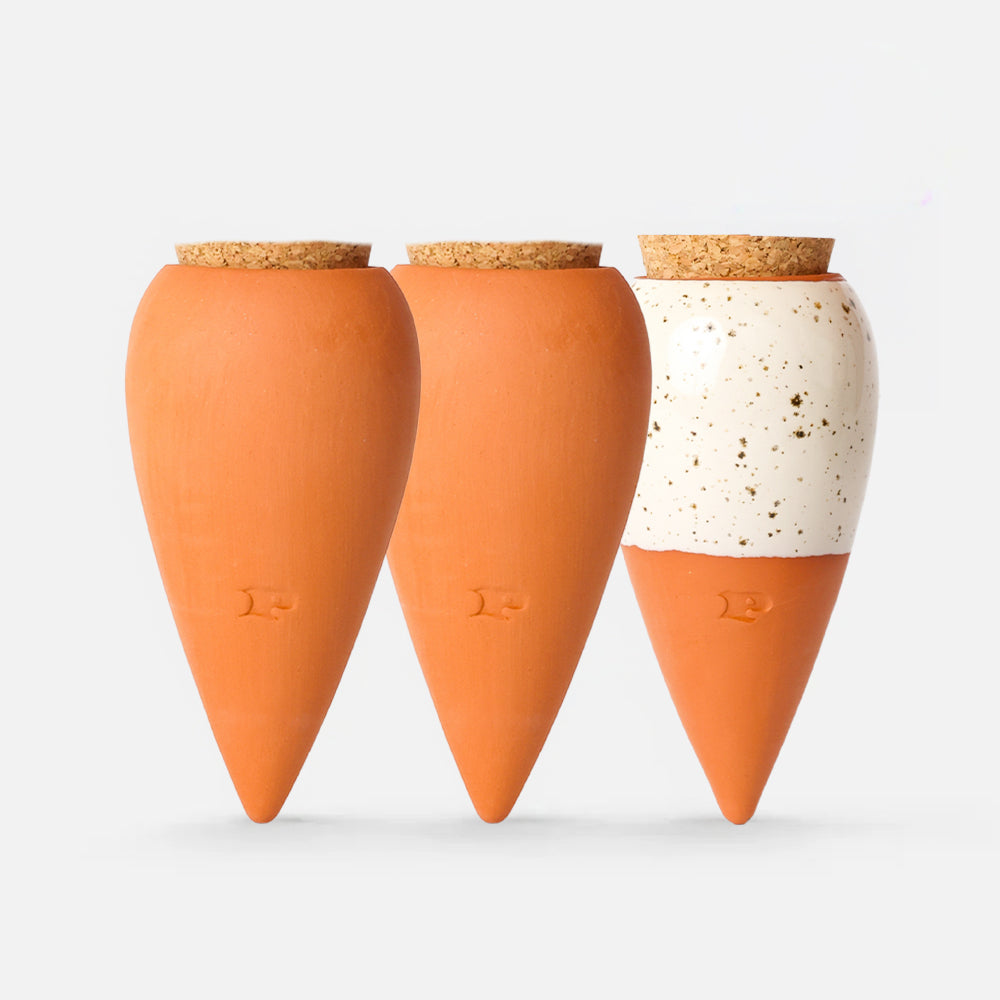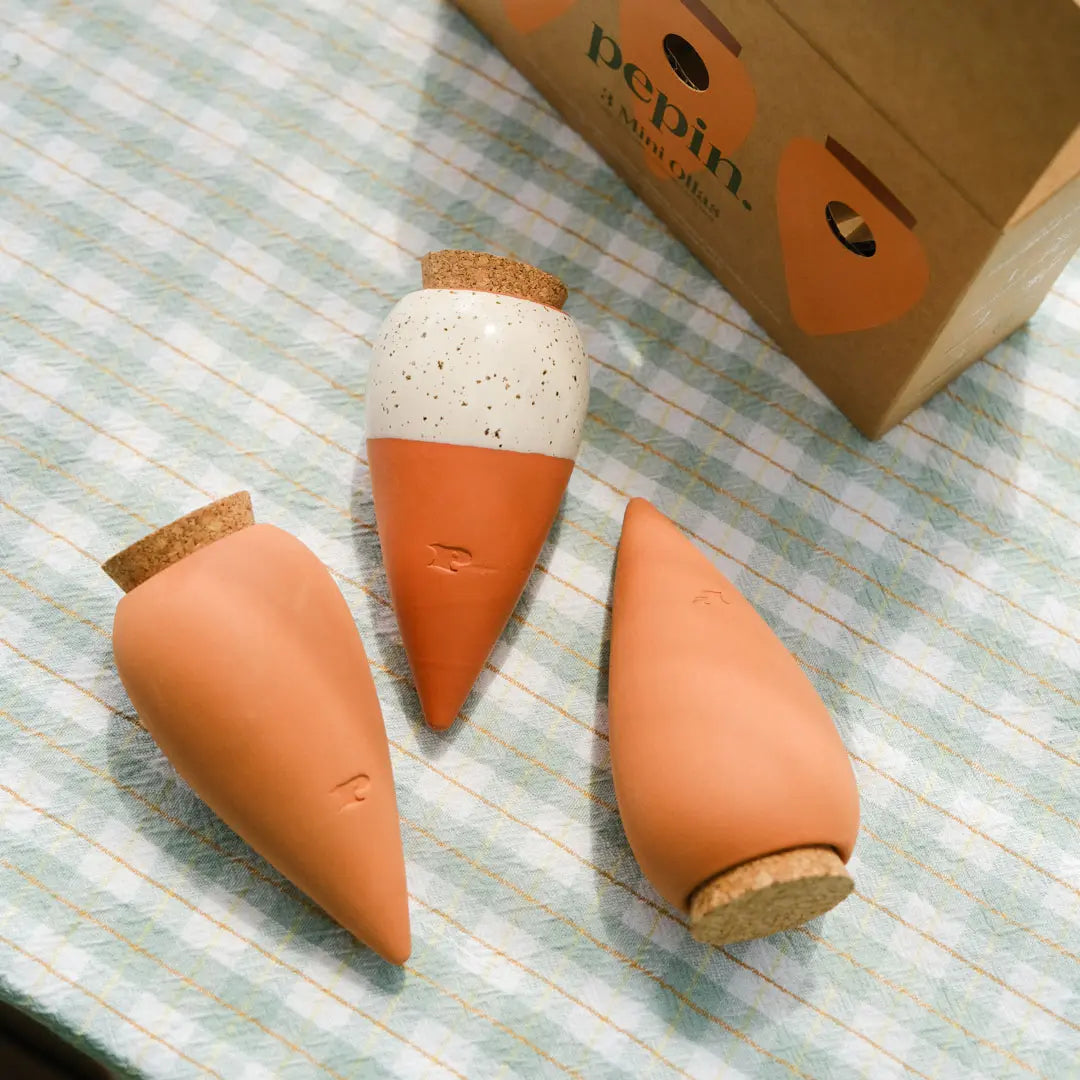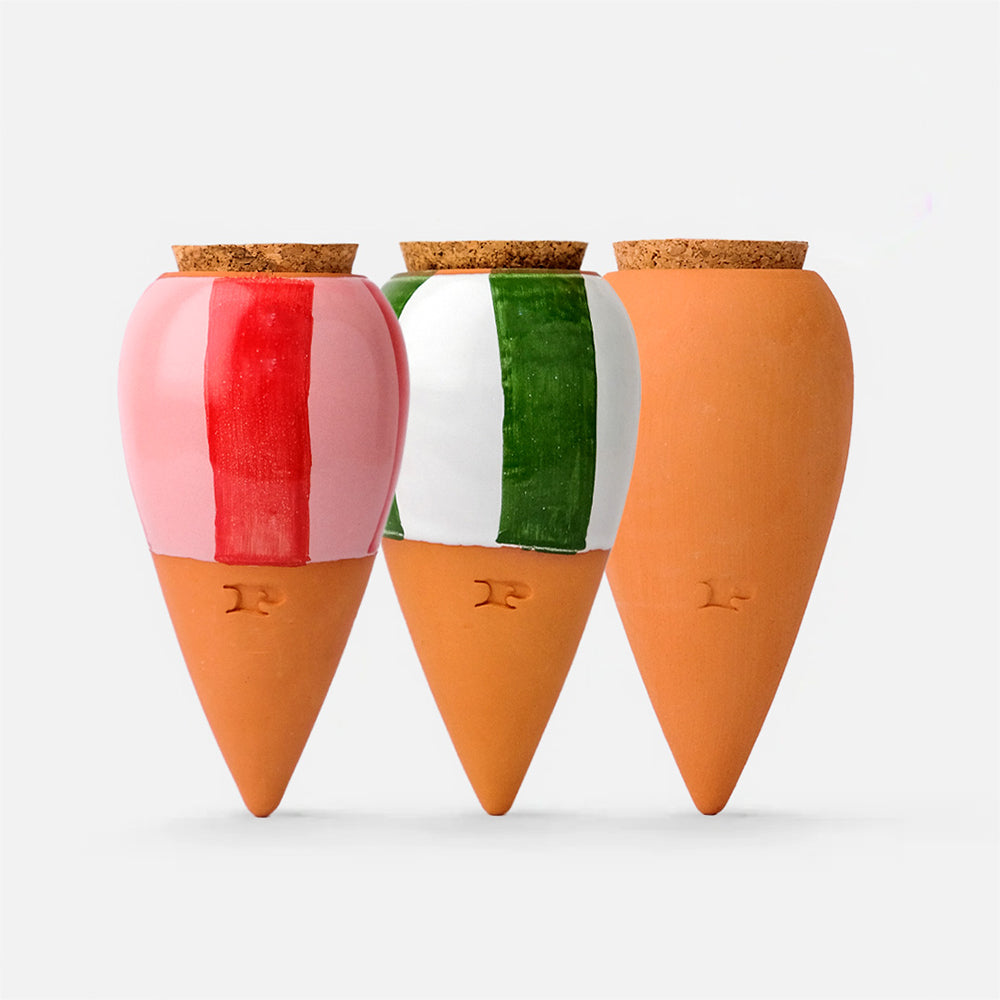

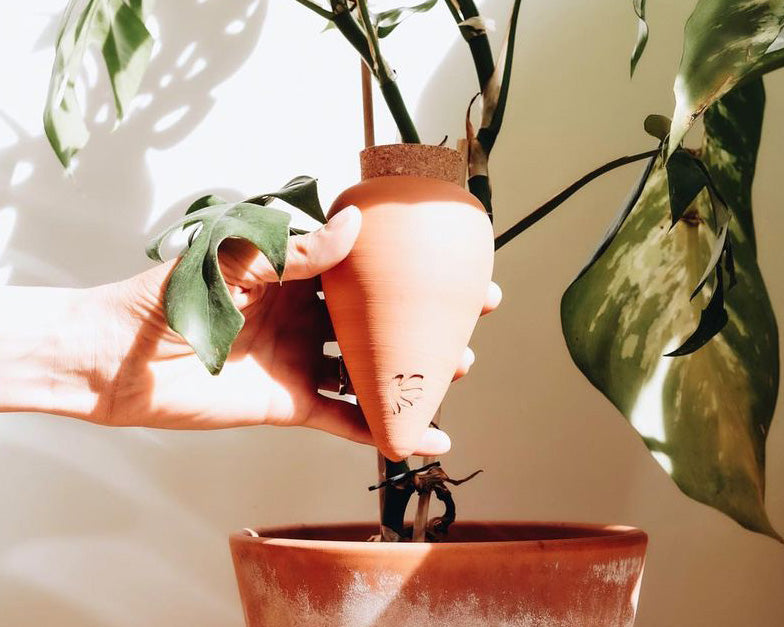
This is the big trend of recent years, combining plant décor and eco-friendly watering. Oyas, those pretty little ceramic jars to plant or bury, are taking over balconies, vegetable gardens and indoor plant pots. Used for millennia and highly prized by permaculture enthusiasts, they have been the subject of research and studies to make them remarkably effective!
What is an oyas?
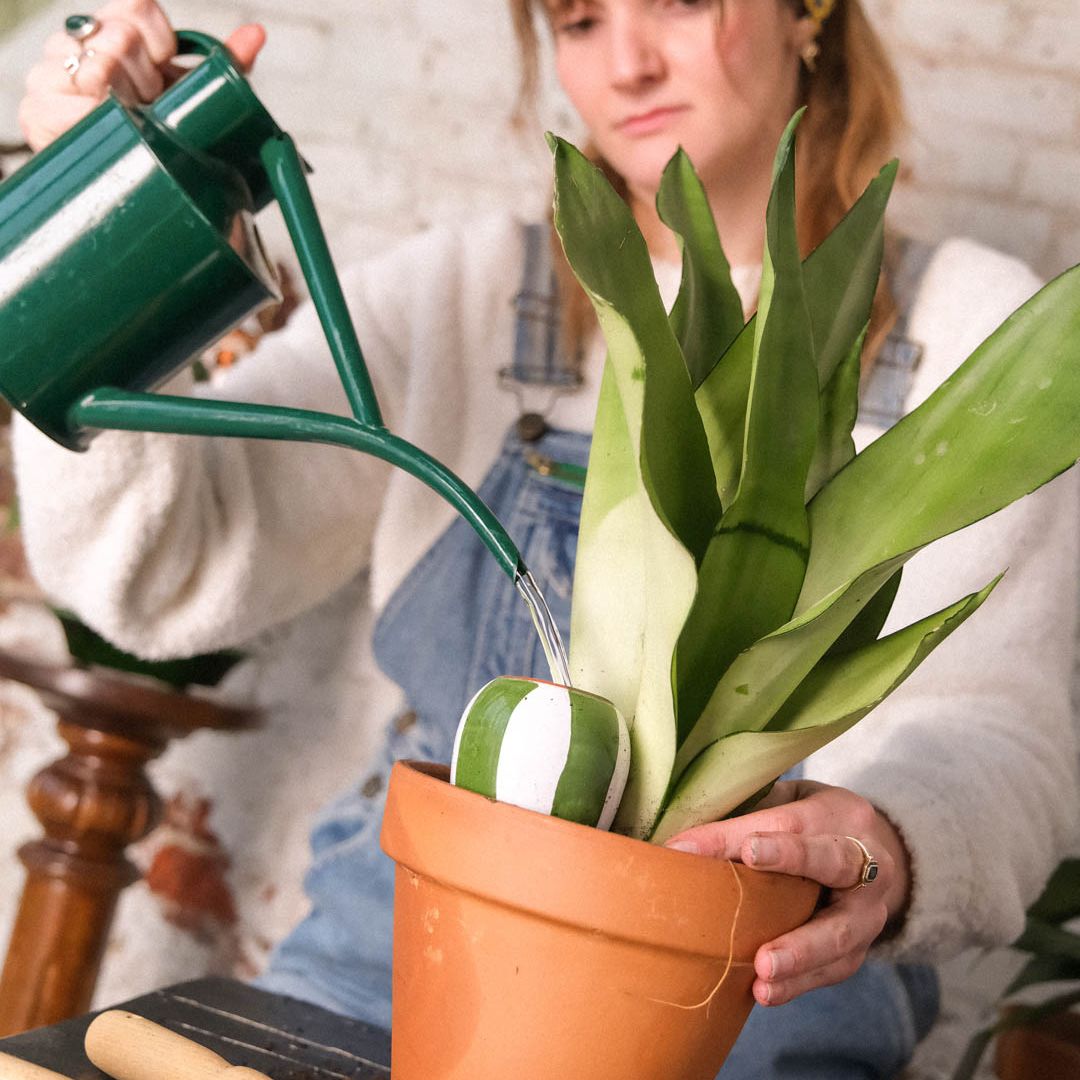
Oyas are microporous ceramic pots used to optimise plant watering. There are oyas to plant in houseplants, and oyas to bury in vegetable gardens and balcony or terrace planters. Their principle is quite simple, and is based on the fundamentals of the first firing art: ceramics.
When making a ceramic piece, it is first shaped by hand before being fired, glazed, and fired again. Depending on the firing temperature, the final piece will be more or less porous (or even completely impermeable, as with stoneware for example). For Oyas, the clay is fired at a very precise temperature to achieve an optimal porosity suited to the needs of plants.
Water is thus diffused gradually to avoid overwatering plants and water losses through evaporation or drainage. Studies have shown that they can achieve water savings of around 40 to 70% (we will see below why this figure can vary).
Over time, not only will the oyas distribute water to the plant, but the plant itself will develop roots in contact with it to absorb the water it needs, the two then working in symbiosis. Oyas can be made from black or white clay, or terracotta, and belong to the earthenware category due to their firing temperature.
The origin of oyas
Jar irrigation is an ancestral technique used for thousands of years. It is notably mentioned in writings found in China dating back more than 2,000 years. It is not known exactly where it originated, but it is certain that it has been used across the entire surface of the planet for hundreds of years. The term oyas comes from a "Frenchification" of olla, which means pot or cooking pot in Spanish.
Oyas were used for a very long time in the context of market gardening in an empirical way, combined with other techniques. In India, for example, they are sometimes combined with buried cotton-soaked threads to compensate for poorly controlled porosity. But in the 1960s, with the rise of permaculture and driven by Bill Mollison who mentioned them in his documentary "The Global Gardener", oyas became the subject of study.
Research was carried out to refine the technique and make it more optimal. This led to the emergence of plantable oyas in the 2000s, enabling their use in urban settings while also giving them a decorative dimension.
What are the benefits of oyas?
The benefits of oyas are numerous. They are economical, ecological, water your plants intelligently, limit the appearance of unwanted weeds, adapt to climatic conditions, and can be used with almost all plants. But let's go into more detail on 3 of them:
Simplifying the watering of houseplants
This is undoubtedly the most important advantage for many of us. Plantable oyas mean you no longer have to worry about when, how, and how much water to use to water your plants. Managing the watering of your plants can sometimes feel like a burden. And today it is the main reason why some people hesitate to invest in plants.
Rightly so, when you consider that it is above all overwatering that kills plants through root rot. The most classic mistake is to think: "I haven't watered my plant in a while, its leaves are wilting, I'll quickly pour a jug of water to be done with it." The results can often be catastrophic. The plant ends up drowning and, deprived of oxygen, the roots eventually rot.
Thanks to oyas, plants can draw the water they need themselves. No more headaches about watering — when the oyas is empty, you simply refill it, and that's that. Most oyas have an autonomy of 4 to 7 days, but the time between two waterings can be a little longer, especially for houseplants, which often need short dry periods to stimulate flowering. So whether you have green fingers or not, oyas will do the work for you, and your plants will grow all on their own.
Saving water
Let's go back to basics and be precise. When you water a plant, the available water will disappear in three ways. If the watering exceeds the soil's retention capacity, it will be drained. Either it will exit through the bottom of the pot, or it will reach the water table in natural soil.
The remaining water will be eliminated through the phenomenon of evapotranspiration. That is to say, part of it will be evaporated from the soil surface, in contact with the heat produced by the sun and the wind. And the other part will be transpired by the plants. This transpiration is a fundamental element of plant life — it allows sap to rise from the roots in order to supply photosynthesis with minerals and to cool the plant. Transpiration is essential.
Oyas are therefore very interesting in that they increase the water reserves in the soil. They prevent losses through evaporation linked to surface watering, while allowing the plant to maintain its transpiration continuously, limiting water stress for plants as much as possible.
Measuring the water savings achieved thanks to oyas is however complex, as it depends on the heat, the type of soil, and rainfall (for outdoor plants). However, it is fair to say that these savings can vary from 40 to 70% depending on these parameters. Which will ultimately help to recoup the investment made when purchasing your oyas.
Maintaining soil fertility and life
The question of living soils has become a major issue in recent years. The considerable work carried out by collectives such as "vers de terre production" highlights the importance of the link between living soil and soil fertility. Simply put, having a soil rich in micro and macro organisms makes it possible to transform organic matter into elements that plants can absorb, and thus to promote their growth.
But to maintain a living soil, you need to provide shelter and sustenance for all this biodiversity. And this is where oyas become particularly interesting! A habitat conducive to life will necessarily need to remain moist. Dry soil in the first 20 cm will block the activity of all this little-known and often invisible fauna and prevent its development.
By combining oyas and mulching, you will boost the fertility of your soils and help keep the first links in biodiversity chains alive — they really need it right now! And your plants will benefit, thriving in a rich and fertile ecosystem. If you are starting a small vegetable patch on poor-quality soil, it can also be useful to combine the installation of oyas with an application of organic fertiliser to stimulate soil activity in spring.
The question of living soils for houseplants is also too little considered, even though it is possible to apply certain principles there, including certain forms of mulching adapted for indoors. If the topic interests you, you will find all the information in our complete guide on organic fertilisers for houseplants and vegetables.