
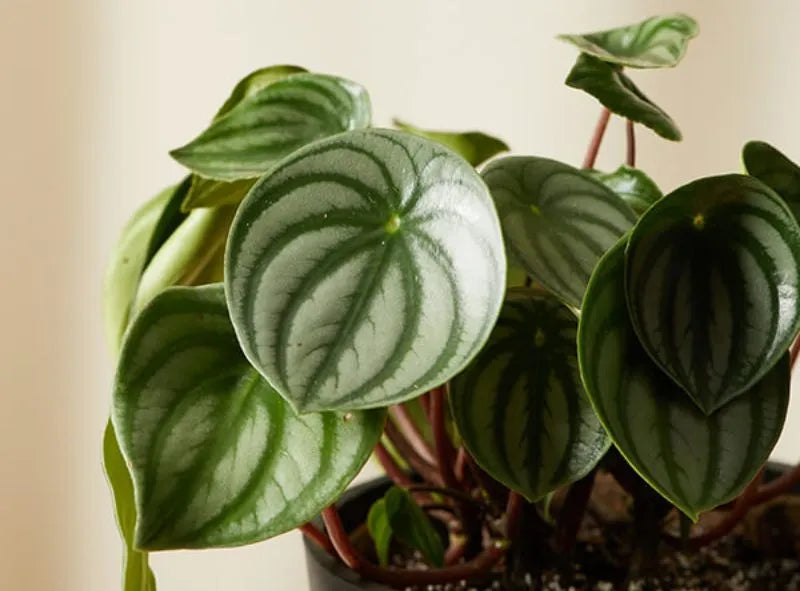
- Light ☀️
They love indirect light but can tolerate lower light conditions
- Watering 💧
They store water in their fleshy leaves, so avoid overwatering (wait until the surface of the soil dries out)
- Signs of an unhappy plant 🤒
Wilted plant, dry soil: Thirsty
Yellowed leaves, black stems: Overwatered
- Ease of care ❤️🩹
❤️🩹❤️🩹❤️🩹❤️🩹/5
🪴 Looking for an easy-to-care-for houseplant? Look no further — the Peperomia is made for you!
The different varieties of Peperomia
Peperomias are pan-tropical plants, meaning they grow above and below the equator, in tropical zones.
Although most peperomias originate from Central and South America as well as Asia, they can also be found in the United States, such as in Florida.
Succulent peperomias, like Peperomia graveolens and Peperomia dolabriformis, have thick, fleshy leaves and stems that retain water.
These plants are ideal for those who prefer minimal maintenance, as they can survive without watering for looooooong periods.
They generally thrive in drier conditions and can even tolerate extended periods of drought.
In short, if you tend to forget to water your plants, this is the species for you!
Some varieties of Peperomia, such as Peperomia incana and Peperomia verticillata, have leaves covered in fuzz. This fuzz protects them from intense sunlight and helps reduce water loss.
They're perfect for low-light spots. So, if you're always complaining that your flat doesn't get enough light, at least you've found a plant that won't mind too much 😌
Varieties like Peperomia caperata, whether in Pearl or Ripple form, have leaves with ridges or grooves (not the concrete-fixing kind, don't worry). They help collect and direct water towards the roots. This variety is ideal for spots where humidity can fluctuate.
Care tips for the Peperomia
Although some varieties of Peperomia can tolerate more intense light, most prefer indirect or moderate light.
The Peperomia prefers well-draining soil. A mix of cactus compost with perlite and a little bark is perfect!
It's important not to leave the soil too moist, as this can cause root rot.
In general, it's best to water moderately and let the soil dry out between waterings.
The Peperomia benefits from light fertilising during its growing season, from March to October. You can use a liquid fertiliser to encourage beautiful growth and lush foliage.
Propagating the Peperomia
Propagating the Peperomia is relatively simple and can be done through leaf cuttings.
Cut a leaf with its petiole, plant it in moist soil, and it will develop new roots and shoots within a few weeks.
To ensure strong, healthy roots for your cutting, you can use willow water.
How to use it couldn't be simpler:
Add 2 full pipettes to 200ml of water, then water after repotting and watch your cutting thrive ✨
The Peperomia is a versatile and easy-to-care-for houseplant, ideal for gardeners from first-timers to unlucky beginners.